Traditional Experience Management (XM) has long suffered from “silo syndrome” and a fundamentally flawed operational paradigm: it relies heavily on reactive data collection, analyzing historical friction after the customer or employee has already disengaged.
The Loop Experience Platform delivers a unified user experience that fundamentally shifts organizations from reactive post-mortems to predictive intelligence. By engineering a complete omni-channel vision, Loop unifies disjointed feedback loops into a single, high-performance ecosystem.
Loop is built AI-first, treating Natural Language Understanding (NLU), generative insights, and autonomous execution not as feature add-ons, but as the foundational runtime of the entire infrastructure.

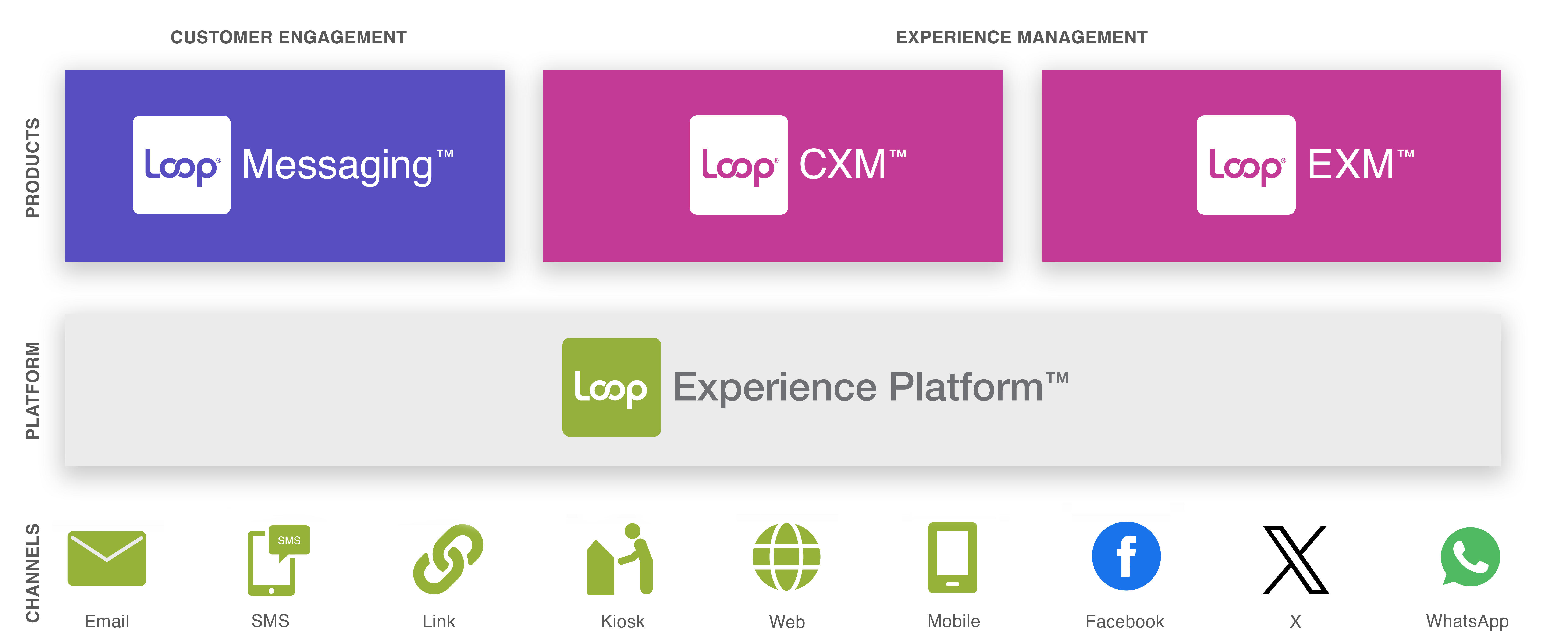
The Loop Experience Platform functions as an all-in-one, multi-channel experience management solution engineered specifically for location-based operations (such as hotels, healthcare facilities, restaurants, retail, and transit hubs). Rather than offering disparate communication tools, its product suite is heavily integrated into a unified software environment consisting of:
Traditional Experience Management (XM) platforms suffer from architectural and functional limitations that prevent organizations from fully capitalizing on customer feedback. The document highlights several critical challenges:
Breaking down programmatic data silos to build a holistic, multi-modal graph of the entire customer and employee journey.
Moving past shallow, pattern-matched sentiment analysis (Positive/Negative/Neutral) to deep Natural Language Understanding (NLU) that systematically exposes structural root causes—the definitive “why” behind the data.
Lowering the barrier to data exploitation by translating complex analytics into high-context, conversational narratives accessible across the entire organizational chart.
Advancing your application security posture while enforcing strict data governance, model alignment, and cryptographic trust frameworks to ensure compliance and transparency.
To transform the Loop Experience Platform from a passive system of record into an autonomous system of action, we have introduced a native orchestration layer: the Loop Agentic AI Suite.
Unlike legacy AI engines that sit idle awaiting user prompts, Loop Agentic AI possesses deterministic agency: it independently understands the operational objective, constantly monitors multi-channel data streams, and initiates algorithmic workflows to close the loop without human intervention.

To deliver on this approach, Benbria is introducing the Loop Agentic AI Suite, a new layer of intelligence built upon four core capabilities:
Moving beyond “what happened” to forecasting “what will happen”. Agents continuously run anomaly detection models against real-time streaming feedback to identify brewing trends and high-risk sentiment shifts before they escalate, instantly triggering programmatic workflows to insulate brand reputation.
Eliminating manual telemetry tagging and rigid, human-defined taxonomies. The architecture dynamically vectorizes text and isolates clusters across tens of thousands of concurrent multi-modal interactions, surfacing “unknown unknowns” that traditional static analytics entirely miss.
Condensing massive distributed datasets into context-aware, low-latency briefings. Generative pipelines abstract cross-location performance data into hyper-tailored operational summaries constructed specifically for the viewing stakeholder’s role.
Interrogating data repositories using natural language interface pipelines. Instead of querying databases or building manual pivot tables, users can issue direct prompts—e.g., “Why did NPS drop in the Northeast last week?”—and receive real-time, data-backed analytical narratives with calculated statistical significance.
Don’t just look at what happened—predict what’s next. See how the Loop Experience Platform and its native Agentic AI Suite can eliminate data silos, automate feedback loops, and transform your operational telemetry into an autonomous system of action.